My Starfish Foundation - Support a Project
Funding
Slider Image
Enhance Wellbeing
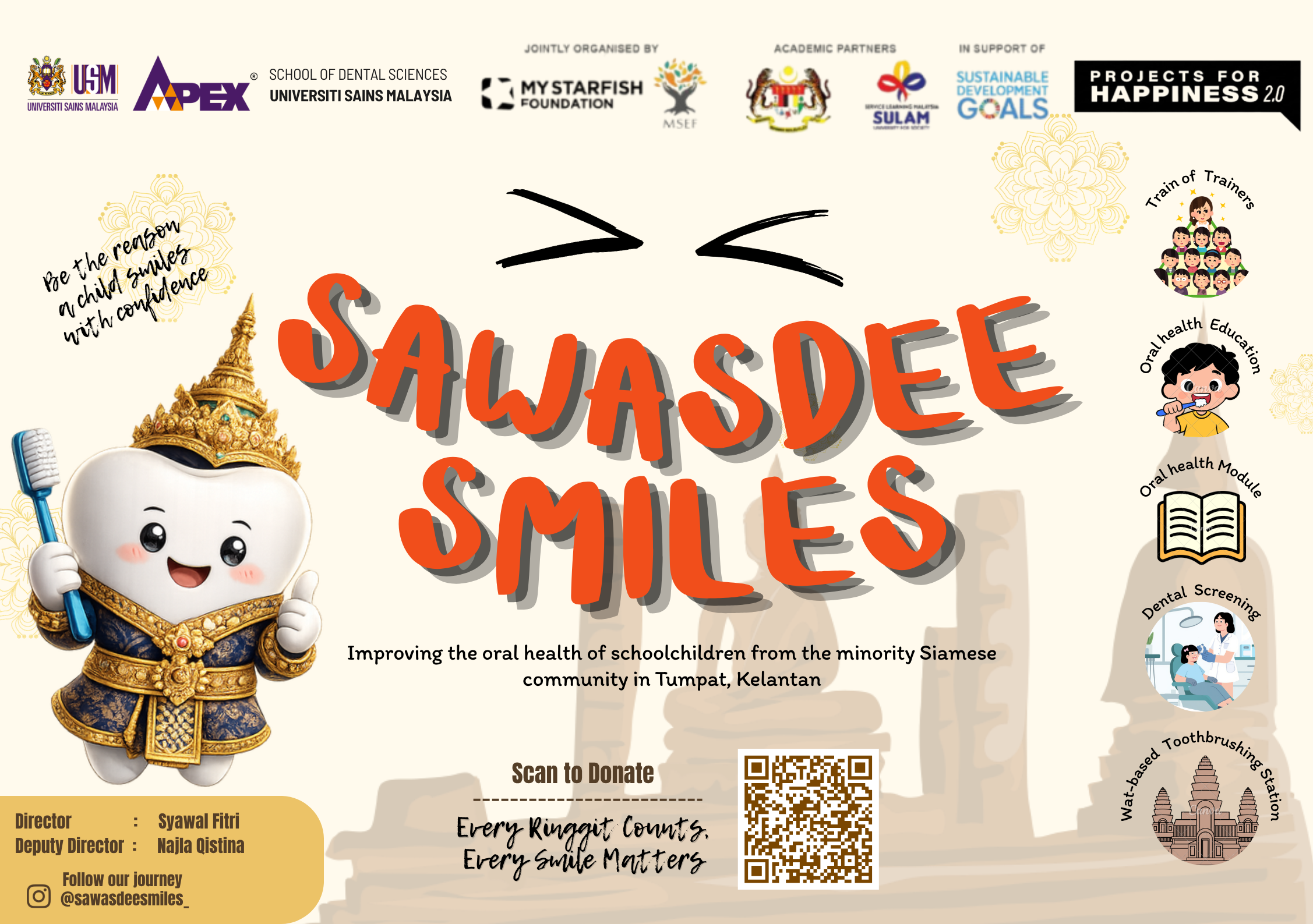
SAWASDEE SMILES : Bridging Oral Health Gaps among Siamese Children in Tumpat
Kelantan records one of the highest prevalences of childhood dental caries in Malaysia viz. 74.6% among preschool children as reported in a study by Dolah in 2020. Dental disease in children can lead to pain, infection, poor nutrition, reduced school attendance, and diminished quality of life.Despite this, minority and underserved communities such as the Siamese (Thai) community in Tumpat remain underrepresented in targeted oral health promotion programmes. Limited access to preventive education and early screening may contribute to untreated oral health problems.As a dental student, I believe that oral health is closely linked to happiness, confidence, and overall wellbeing. Early, preventive, and community-based interventions are essential to create meaningful and lasting impact. Project Objectives: To improve oral health knowledge among preschoolers and schoolchildren among the Siamese community in Tumpat.To conduct basic dental screenings for early identification of common oral health problems.To transfer oral health knowledge to teachers and community leaders through Train of Trainers (ToT).To assess oral health related knowledge, attitude and practice (KAP) pre- and post- intervention among teachers, community leaders and parents. Supporting Sawasdee Smiles is an investment in health equity and cultural preservation for the underserved Thai minority of Tumpat, a community currently at risk due to unknown caries prevalence and linguistic barriers to mainstream healthcare. By integrating clinical screenings with culturally resonant education—facilitated through the local Wat and bilingual resources—this project transitions from a simple dental check-up into a sustainable community ritual that protects children from the debilitating cycle of chronic oral pain and the subsequent financial strain on family livelihoods. Your support empowers a "pioneer intervention" that not only improves the immediate wellbeing and social confidence of these children but also establishes a scalable, data-driven blueprint for how modern medicine can respectfully and effectively serve Malaysia’s unique cultural enclaves.
RM 523.00
62%
Goal: RM 839.30
21 Days Left
Funding
Slider Image
Arts & Culture
寻迹士乃 Loi Ah, Cim Ziak Hi
Kampung Baru Senai is a Chinese new village in Johor with rich Hakka heritage, community memories, and everyday cultural stories. These stories live in places such as Kong Hay Tong, traditional kuih stalls, the old theatre, SJK(C) Senai Museum, Senai River, and old railway traces.However, many young people who live around these places do not fully understand their meanings. To them, these sites may look ordinary, but behind them are stories of migration, resilience, family values, community support, and cultural spirit.The issue is not that Senai’s culture has disappeared. The issue is that it is no longer being actively communicated across generations. Elder stories, oral histories, and local memories may slowly fade if they are not documented and shared in a way that young people can understand and connect with.寻迹士乃 Loi Ah, Cim Ziak Hi responds to this issue by creating an AI-enabled cultural learning route for young people. The project brings together the Trace Soul AI cultural guide, Trace Pack mission kit, an 8-stop cultural route, site-based activities, Trace Wall reflections, video documentation, a Heritage Zine, and a Cultural Learning Map.Through this experience, participants will not only receive information about Senai, but actively explore, ask questions, listen to stories, complete missions, and reflect on their relationship with local culture. AI is used as a bridge to support intergenerational dialogue, not to replace elders or human connection.We have received RM7,000 grant support through Project for Happiness 2.0, and we are now raising an additional RM3,000 to complete the production and implementation of this project.Your contribution will help us produce learning materials, document community stories, and bring this cultural learning route to young participants. By supporting this project, you are helping preserve Senai’s cultural memory and giving young people a meaningful way to understand, experience, and carry their heritage forward.
RM 10.00
0%
Goal: RM 3,000.00
21 Days Left
Funding
Slider Image
Helping the Underprivileged Community
Community-Based Sustainable Paver Initiative for Rural Accessibility
In rural areas surrounding Universiti Tun Hussein Onn Malaysia (UTHM), community prayer facilities (surau) play an important role not only as places of worship but also as centres for social interaction, meetings, and community activities. In many kampung settings, the pedestrian circulation areas surrounding these facilities are often characterised by uneven, unpaved surfaces and exposed ground conditions, which pose safety risks to users. These issues are particularly significant for elderly individuals, children, and persons with disabilities who require safe and stable access to shared community spaces.During periods of rainfall and localised flooding, the lack of proper pedestrian walkways further increases the risk of slips, falls, and limited accessibility, reducing the usability of the surau as a key community hub. Improving the immediate surroundings of such facilities is therefore important to enhance safety, accessibility, and overall community wellbeing.This project is carried out by the Concrete Society Malaysia (CSM), Universiti Tun Hussein Onn Malaysia, with the aim of improving pedestrian safety and accessibility around a rural community prayer facility through the production and installation of precast concrete paver blocks. These pavers will be manufactured using Cement Board Waste (CBW) and Palm Oil Fuel Ash (POFA) as partial replacements for cement and fine aggregates at laboratory in UTHM and the installation will utilise an existing asphalt base, allowing for a cost‑effective and efficient intervention with minimal site disturbance. The pavers will be manufactured in a laboratory at UTHM by the CSM team and installed the surau through collaboration with the local community and civil engineering expertise provided by UTHM student entrepreneur contractors. The project will receive professional advice from UTHM’s student entrepreneur network, including those who have successfully established contractor companies while pursuing advanced studies. Their industry experience including exposure to consultancy projects abroad ensures that technical guidance and professional practices are integrated into the construction process. This highlights how student innovation and entrepreneurship can directly support community development.Beyond physical infrastructure improvement, the project also provides hands‑on learning opportunities for civil engineering students by applying engineering knowledge to real‑world community challenges. Support from My Starfish Foundation and the public is essential to enable the procurement of materials and resources required for paver production and site implementation. With adequate support, this initiative has the potential to serve as a replicable, community‑based engineering model for improving pedestrian accessibility at rural community facilities in the future.   
RM 0.00
0%
Goal: RM 785.80
21 Days Left
Funding
Slider Image
Enhance Wellbeing
The Kids' Health Passport: Holistic Health Programme @ Chow Kit
In the heart of Kuala Lumpur, the Chow Kit community is home to many children growing up in vulnerable and high-risk environments. Many of them come from low-income, marginalized, and undocumented families, where financial instability and limited access to essential services shape their daily lives. Because of these circumstances, consistent healthcare, proper nutrition, and early health education are often not accessible. Preventive healthcare is especially limited, leading many families to seek medical attention only when illnesses have already become severe. Over time, this has created a pattern where healthcare is largely reactive instead of preventive, with health issues being addressed only after they have progressed. This lack of early intervention and health awareness contributes to a range of ongoing health and social challenges among children and adolescents in the area. Issues such as poor hygiene practices, untreated medical conditions, and limited understanding of personal health and safety remain common. At the same time, exposure to social risks, including substance abuse, neglect, exploitation, and unsafe living conditions, further increases their vulnerability. Without proper access to health education and preventive care, these challenges often extend into later life and affect overall physical, emotional, and social well-being.  
RM 1,331.00
33%
Goal: RM 4,000.00
21 Days Left