Support this Project



 0 Days Left
 20 Supporters
 0 Favourited

During a community volunteer program, I was in charge of doing a cognitive test to the participants from public. There, I met a 93-year-old grandmother. Even though, after the test, she was tested to have dementia, but throughout the test, she wasn't talking anything about her memory or her health. Instead, she kept repeating four simple, yet heartbreaking words: "I miss my grandchild". What if "I miss my grandchild" was not just her, but the others as well? It is sad to say that, more than 54% of our elderly have absolutely no intergenerational exchange with children. When they are socially isolated, they can face an 88% higher risk of developing muscle loss, and a 50% higher risk of dementia.
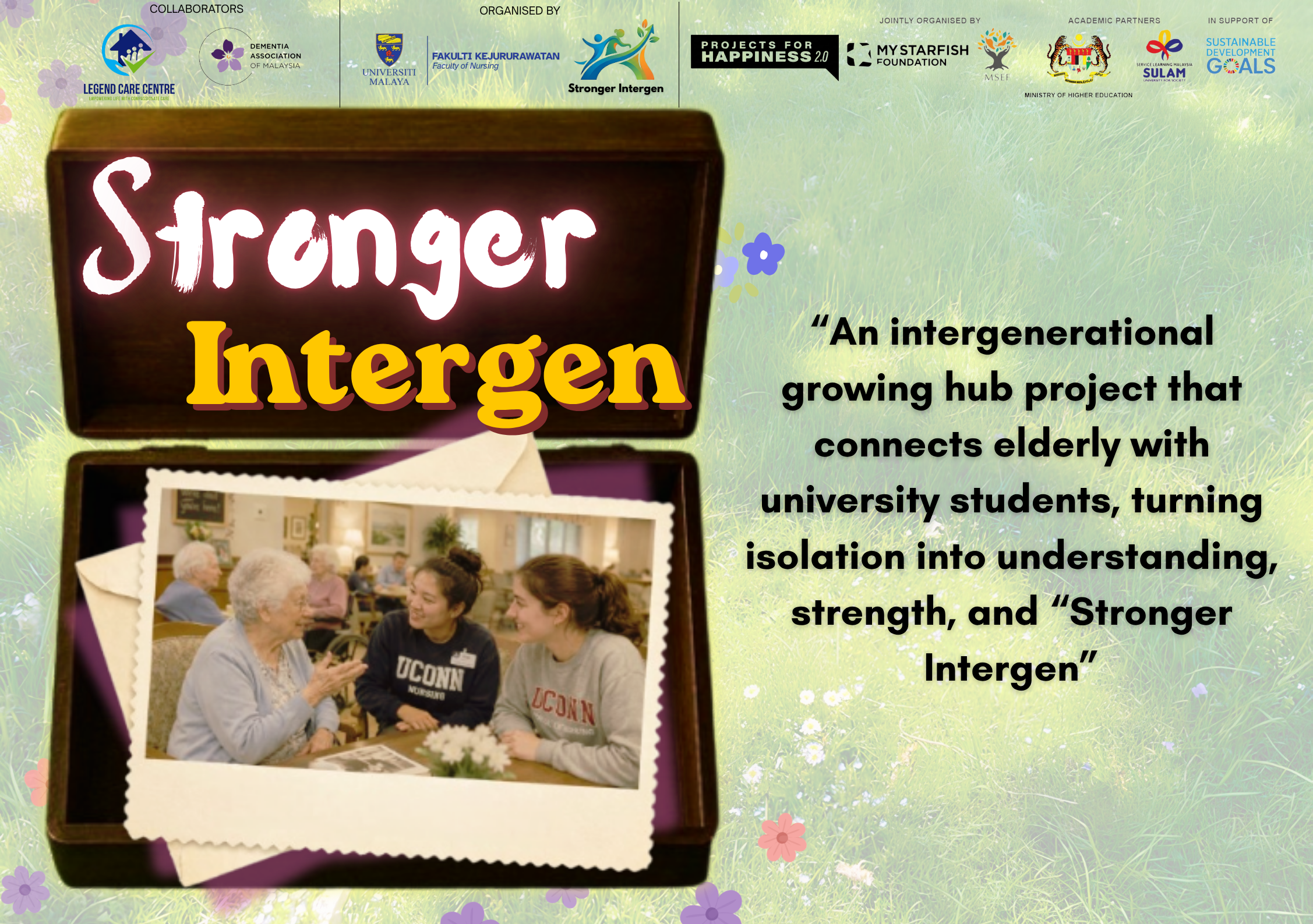
Sometimes, what keeps a person alive inside is not medicine, but being remembered by someone who chooses to show up. Stronger Intergen is a continuous intergenerational hub that brings university students and elderly together to turn “I miss my grandchild” into “Someone is here with me.”
"Stronger Intergen" turns "I miss my grandchild" into "Someone is here with me" by building a permanent intergenerational hub that connects university students with the elderly through structured play, movement, and meaningful interaction. We strive to raise awareness among university students about the importance of respecting the wisdoms of the elderly and connect with their own family and to make this project permanent in UM's Volunteer Program.
To make this realistic, we will first start small by having 4 pilot sessions by each session connecting 8 university students with elderly in Legend Care Centre on first 4 Saturdays of August. Together, they have session together that are designed to not only reduce loneliness and improve the mood of the elderly, but the university students get to understand more about the elderly, care of the elderly, and develop empathy towards the elderly. Continuous collection of data and feedback are conducted through Google Forms, photos, videos and interviews to evaluate and refine the sessions.
After our 4‑week pilot sesions + refinement of the sessions, we will submit our project to Centre for Integral Learning (CITRA) UM and Universiti Malaya Community Engagement Centre (UMCares) with volunteer training materials and classes to become an official volunteer module. There, "Stronger Intergen" volunteer program can become long term permanent project whereby more students get to know the difficulties of the elderly and appreciate more with their own family and expand to more nursing homes across Malaysia.
1) Elderly
Before each session
Ask How do you feel now? (Rate using Wong-Baker Pain Rating Scale)
After each session
a) Interviews randomly with the university students or by themselves
b) Simple questionnaires (To know the effectiveness of the session)
- How do you feel now? (Rate using Wong-Baker Pain Rating Scale)
- Did you enjoy interacting with the students? (Yes/No)
2) Volunteers
*All data are collected after getting the volunteers’ consent
Before each session
Purpose : To know the effectiveness of the session in changing their perception towards elderly and the engagement of the session.
- Simple questionnaires using Google Form
- Any experience interacting with the elderly
- Rating of perception of the elderly (Scale 1-5)
- Rating of understanding the challenges faced by the elderly (Scale 1-5)
- Rating of feeling comfortable interacting with the elderly who may have memory or communication difficulties (Scale 1-5)
- Rating of belief whether intergenerational activities benefit both students and the elderly (Scale 1-5)
- Anything hope to gain or learn from the program
After each session
a) Interviews randomly with the elderly or by themselves
b) Google Form questions
- Rating of perception of the elderly (Scale 1-5)
- Rating of understanding the challenges faced by the elderly (Scale 1-5)
- Rating of feeling comfortable interacting with the elderly who may have memory or communication difficulties (Scale 1-5)
- Rating of belief whether intergenerational activities benefit both students and the elderly (Scale 1-5)
- “How has this intergenerational volunteer experience changed your perspective on older adults, and what is the most meaningful lesson you will take away from it?
 0 Days Left
20 Supporters
0 Favourited
0 Days Left
20 Supporters
0 Favourited