

 Support this Project



Funding
 0 Days Left
 19 Supporters
 1 Favourited
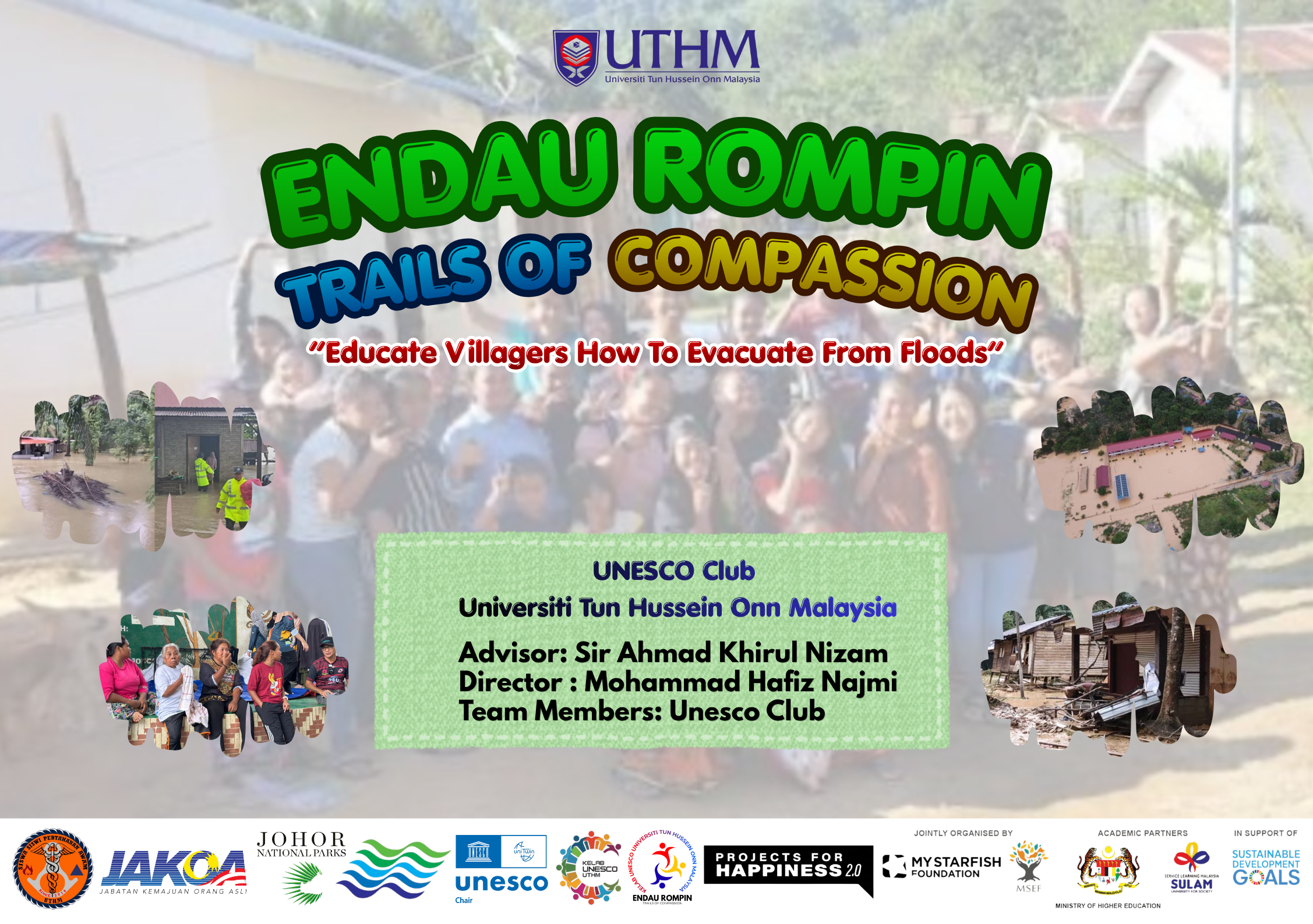
Endau-Rompin: Trails of Compassion
Helping the Underprivileged Community
The problem that this project aims to address and why it is importantThe village is located in a high risk flood zone. Kampung Peta is situated in an area that experiences severe and rescurring floods every year. This makes the community extremely vulnerable to flood related disaster.The only road to the village is frequently cut off during floods. When heavy rains and flooding occur, the single access road leading to Kampung Peta becomes completely impassable. Vehicles cannot enter or leave the village.Residents become stranded with no access to external aid. The road is totally cut off no emergency services, food supplies, clean water or medical help can reach the villagers. They are left completely isolated until floodwaters recede.Why this problem is important to address:Lives are at risk. Pregnant women, children, and elderly villagers are the most vulnerable during floods. Without proper safety tools and knowledge they face serious danger including drowning, injury and illness.The problem is recurring not one-time. It is because floods happen every year, temporary solutions are not enough. The community needs sustainable, long term flood preparedness.Purpose and goals of the project:To provide essential flood safety tools. The project will supply physical equipment such as directional signs, boat and flood safety kits that the community can use during and after floods.To provide flood safety knowledge. Through briefings and simulations conducted by Siswa Siswi Pertahanan Awam (SISPA) UTHM, villagers will learn how to respond during a flood, where to evacuate and how to use the safety equipment peoperly.To increase community resillience. The ultimate goal is to ensure that Kampung Peta can prepare for survive through and recover from floods without relying entirely on external help.Why the public should support this project:A small contribution creates a big impact. The total project cost is manageable, but it will directly benefit 306 villagers. Every ringgit donated goes toward saving lives.Prevents suffering. Each flood safety kit can help one family survive 3 to 5 days without food, water, or medical aid. The boat can rescue pregnant women, children, and elderly villagers from rising floodwaters. The directional signs can guide families to safety before it is too late.Builds long-term sustainability, not just one-time aid. Unlike disaster relief that arrives after a flood, this project prepares the community before the next flood happens. The directional signs stay in place for years. The boat can be reused for every flood. The training and knowledge remain with the villagers permanently.The boat is a critical, life-saving asset. When the road is cut off, a boat is not a luxury but it is a necessity. Without a boat, no rescue can happen. No food or medicine can be delivered. The boat alone can mean the difference between life and death for stranded families.

University/College
Universiti Tun Hussein Onn Malaysia (UTHM)
RM 710.00
Goal:
RM 700.00
Fund Approved by MSF:
RM 3,620.00
101%

The problem that this project aims to address and why it is important
- The village is located in a high risk flood zone. Kampung Peta is situated in an area that experiences severe and rescurring floods every year. This makes the community extremely vulnerable to flood related disaster.
- The only road to the village is frequently cut off during floods. When heavy rains and flooding occur, the single access road leading to Kampung Peta becomes completely impassable. Vehicles cannot enter or leave the village.
- Residents become stranded with no access to external aid. The road is totally cut off no emergency services, food supplies, clean water or medical help can reach the villagers. They are left completely isolated until floodwaters recede.
Why this problem is important to address:
- Lives are at risk. Pregnant women, children, and elderly villagers are the most vulnerable during floods. Without proper safety tools and knowledge they face serious danger including drowning, injury and illness.
- The problem is recurring not one-time. It is because floods happen every year, temporary solutions are not enough. The community needs sustainable, long term flood preparedness.
Purpose and goals of the project:
- To provide essential flood safety tools. The project will supply physical equipment such as directional signs, boat and flood safety kits that the community can use during and after floods.
- To provide flood safety knowledge. Through briefings and simulations conducted by Siswa Siswi Pertahanan Awam (SISPA) UTHM, villagers will learn how to respond during a flood, where to evacuate and how to use the safety equipment peoperly.
- To increase community resillience. The ultimate goal is to ensure that Kampung Peta can prepare for survive through and recover from floods without relying entirely on external help.
Why the public should support this project:
- A small contribution creates a big impact. The total project cost is manageable, but it will directly benefit 306 villagers. Every ringgit donated goes toward saving lives.
- Prevents suffering. Each flood safety kit can help one family survive 3 to 5 days without food, water, or medical aid. The boat can rescue pregnant women, children, and elderly villagers from rising floodwaters. The directional signs can guide families to safety before it is too late.
- Builds long-term sustainability, not just one-time aid. Unlike disaster relief that arrives after a flood, this project prepares the community before the next flood happens. The directional signs stay in place for years. The boat can be reused for every flood. The training and knowledge remain with the villagers permanently.
- The boat is a critical, life-saving asset. When the road is cut off, a boat is not a luxury but it is a necessity. Without a boat, no rescue can happen. No food or medicine can be delivered. The boat alone can mean the difference between life and death for stranded families.
Installation of Directional Signboards (in English, Malay and Jakun language)
- The project team will install directional signboards around Kampung Peta that show safe evacuation routes and flood-safe areas.
- The signboards will be written in the local Jakun dialect so that all villagers, including elders, can understand them.
- This activity directly supports the goal of providing flood safety tools and increasing community resilience.
Provision of 60 Flood Safety Kits to all households
- The project will distribute 60 complete flood safety kits, one kit for every household in Kampung Peta (60 houses).
- Each kit contains food (energy bar), clean water, a light source, and first aid supplies.
- These kits allow each family to survive for 3 to 5 days without external help when the road is cut off during floods.
Provision of 1 Rescue Boat
- The project will provide one rescue boat to the community for emergency use during high floods.
- The boat will be used to rescue stranded villagers, especially pregnant women, children, and the elderly.
- It can also transport emergency food, water, and medicine into the village when no vehicles can enter because the road is cut off.
Flood Safety Briefing by SISPA UTHM
- SISPA UTHM (Siswa Siswi Pertahanan Awam) will conduct a flood safety briefing for all villagers.
- The briefing will cover what to do before, during, and after a flood, how to use the flood safety kits, and how to stay safe during evacuation.
Flood Simulation and Gotong-Royong (Community Work)
- A flood simulation drill will be conducted so villagers can practice evacuation procedures and using the rescue boat.
- A gotong-royong (community clean-up) session will also be held to clean drains and clear blockages around the village, which helps prevent future floods from becoming severe.
Closing Ceremony and Distribution of Flood Safety Kits
- A closing ceremony will be held to acknowledge the participation of villagers, volunteers, and partners.
- The 60 flood safety kits will be officially distributed to all households during the ceremony.
Improved flood preparedness and evacuation efficiency
- Impact: Villagers will know exactly where to go during a flood and how to evacuate safely using directional signboards (in Jakun language) and the rescue boat.
- Metrics & Measurement: 100% of the 306 villagers will be able to identify at least one safe evacuation route using the new signboards, measured through a post-training survey or drill observation. Target reduction in evacuation time for vulnerable individuals (pregnant women, children, elderly) to safe zones within 30 minutes of flood warning, measured during flood simulation drill. 80% or more of participants demonstrate correct understanding of signboard symbols and meanings, measured through a simple quiz or practical test after the safety briefing by SISPA UTHM.
Increased community survival capacity during road isolation
- Impact: When the road to Kampung Peta is cut off during floods, each household can survive independently for 3 to 5 days without external aid using flood safety kits.
- Metrics & Measurement: 60 households (100% of all homes) receive one complete flood safety kit each, containing food (energy bar), clean water, light source, and first aid supplies, confirmed through distribution records. 100% of households can demonstrate how to properly use the items in the kit, measured during post-distribution practical checks. Target zero starvation or dehydration-related incidents during future flood events among the 306 villagers, measured through post-flood community health reports.
Strengthened long-term community resilience and ownership
- Impact: The community will take ownership of flood safety activities, maintaining signboards and continuing safety drills on their own after the project ends.
- Metrics & Measurement: At least 1 community member (village elder or appointed safety leader) is trained to inspect and maintain directional signboards every 6 months. At least 70% of villagers participate in at least one self-organized flood drill within 12 months after project completion, measured through attendance records kept by village leaders. Reduction in external aid dependency measured by tracking how many families rely solely on their own flood safety kits versus waiting for government or during the next flood event.

Nur Diyana Binti Baddal
RM 10.00
3 months ago
3 months ago
nurwani
RM 3.00
3 months ago
3 months ago
ELVIRA ANN ALEXZANDER
RM 10.00
3 months ago
3 months ago
Irfan
RM 15.00
3 months ago
3 months ago
Funding
0 Days Left
19 Supporters
1 Favourited
Endau-Rompin: Trails of Compassion
Helping the Underprivileged Community
The problem that this project aims to address and why it is importantThe village is located in a high risk flood zone. Kampung Peta is situated in an area that experiences severe and rescurring floods every year. This makes the community extremely vulnerable to flood related disaster.The only road to the village is frequently cut off during floods. When heavy rains and flooding occur, the single access road leading to Kampung Peta becomes completely impassable. Vehicles cannot enter or leave the village.Residents become stranded with no access to external aid. The road is totally cut off no emergency services, food supplies, clean water or medical help can reach the villagers. They are left completely isolated until floodwaters recede.Why this problem is important to address:Lives are at risk. Pregnant women, children, and elderly villagers are the most vulnerable during floods. Without proper safety tools and knowledge they face serious danger including drowning, injury and illness.The problem is recurring not one-time. It is because floods happen every year, temporary solutions are not enough. The community needs sustainable, long term flood preparedness.Purpose and goals of the project:To provide essential flood safety tools. The project will supply physical equipment such as directional signs, boat and flood safety kits that the community can use during and after floods.To provide flood safety knowledge. Through briefings and simulations conducted by Siswa Siswi Pertahanan Awam (SISPA) UTHM, villagers will learn how to respond during a flood, where to evacuate and how to use the safety equipment peoperly.To increase community resillience. The ultimate goal is to ensure that Kampung Peta can prepare for survive through and recover from floods without relying entirely on external help.Why the public should support this project:A small contribution creates a big impact. The total project cost is manageable, but it will directly benefit 306 villagers. Every ringgit donated goes toward saving lives.Prevents suffering. Each flood safety kit can help one family survive 3 to 5 days without food, water, or medical aid. The boat can rescue pregnant women, children, and elderly villagers from rising floodwaters. The directional signs can guide families to safety before it is too late.Builds long-term sustainability, not just one-time aid. Unlike disaster relief that arrives after a flood, this project prepares the community before the next flood happens. The directional signs stay in place for years. The boat can be reused for every flood. The training and knowledge remain with the villagers permanently.The boat is a critical, life-saving asset. When the road is cut off, a boat is not a luxury but it is a necessity. Without a boat, no rescue can happen. No food or medicine can be delivered. The boat alone can mean the difference between life and death for stranded families.
University/College
Universiti Tun Hussein Onn Malaysia (UTHM)
RM 710.00
Goal:
RM 700.00
Fund Approved by MSF:
RM 3,620.00
101%


